Page 6 – Just Bare Foods
Love Just Bare ? Leave us a review!

Solstice Celebrations

Light fare, both kinds.

The farther north you live, the more you appreciate the significance of the summer solstice, the first day of summer. To reach this point, it’s taken six months for the days to get longer and the nights to get shorter, and in some places the transition is extreme. Take Sweden’s northernmost town of Kiruna, located above the Arctic Circle. In December on the first day of winter, the sun never even rises above the horizon, and it’s not until the first week of January that residents see the sun again. From there, it’s a slow but steady march to the summer solstice in June with a full 24 hours of sunlight. Reason to celebrate? Yes, Sweden has every reason to celebrate the solstice.

The midsommar smorgasbord.

Other cultures, of course, celebrate the summer solstice too. If you’re in Austria on the first day of summer, you might see bonfires on mountain peaks. If you’re in Portugal, you might cheer for fireworks filling the night sky for St. John’s Day.

But if you’re in Sweden, you want to leave the city and get outdoors, preferably at a lake cabin or by the sea. Family and friends are there with plenty of food and drink, and to keep things active and informal, buffets are perfect for bringing people together and keeping the festivities moving. After all, the term smörgåsbord is Swedish, and this sometimes lavish array of food items can include hot and cold meats, breads, cheeses, fresh berries, fresh produce and more. Finger foods are a great way to fuel the fun, and that means one favorite is required, Swedish meatballs.

A new spin on meatballs.

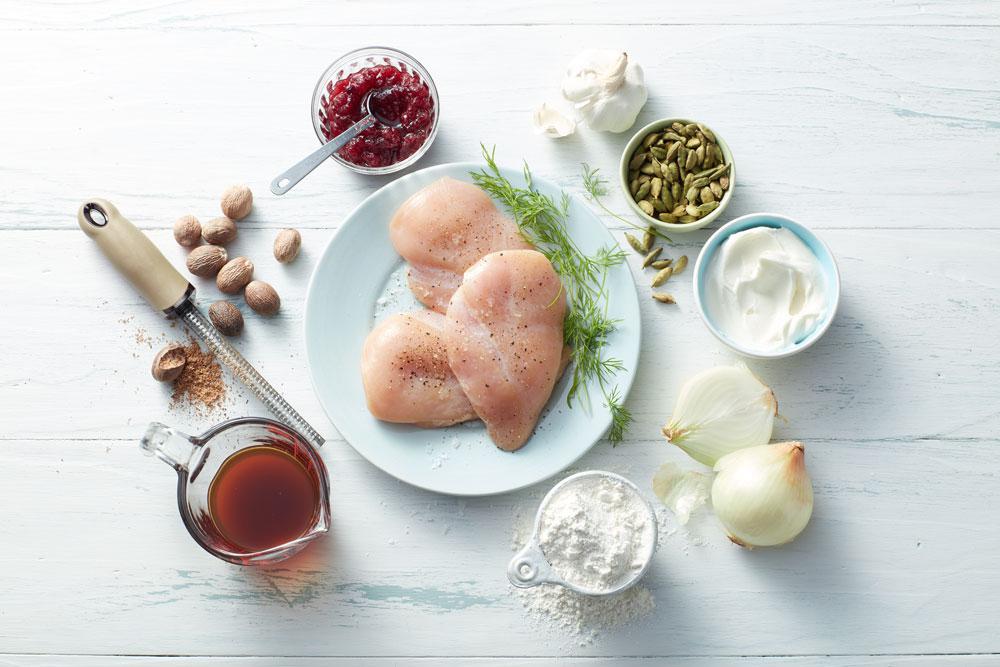
Classic Swedish meatballs, or köttbullar, are usually made with a ground meat mixture of beef and pork. But since the goal of midsummer is being active and making the most of every minute of daylight, why not lighten things up with Swedish-Style Chicken With Creamy Dill Gravy? It’s a quick, delicious recipe. Simply cube boneless skinless chicken breasts into 1-inch squares and sauté. Then make the gravy in the same skillet and combine. Less time cooking, more time celebrating. That’s the way to savor the solstice.

Summer at its peak.

Swedish-Style Chicken With Creamy Dill Gravy takes advantage of seasonal herbs, in this case chopped fresh dill. But there’s so much more available at local farmers markets or growing in home gardens. Start planning your solstice celebration or summer feast today. The long, leisurely days of midsummer don’t last forever. Such golden moments are truly times of celebration.

Gumbology

All together now.

The story of gumbo is the story of America itself. It draws its essence from the coming together of people and foods in new ways, each bowl an acknowledgement of the contributions of many cultures and traditions. Far from a singular dish, gumbo varies according to the region, the season and especially the cook. Even in New Orleans and southern Louisiana, the heart of gumbo country, there are countless variations, differing from other versions found along the Gulf Coast and Atlantic seaboard. Gumbo is what you make of it. Gumbology is a look at the art and science.

First things first.

In the cooking traditions of New Orleans and southern Louisiana, three vegetables set the stage for many signature dishes — onions, bell peppers and celery. Known as the “holy trinity,” their flavors are a key part of most gumbo recipes. But another veggie is even more important — okra. This essential gumbo ingredient originated in Africa, and it’s West African name, ki ngombo or gombo, is the likely origin of the word “gumbo.”

Okra is used as a natural thickener, as is filé, another plant-based cooking ingredient favored by the native Choctaw people of Louisiana and other indigenous tribes in the South. Filé is a powder made by drying and grinding the leaves of the sassafras tree, and it too is a common thickening agent in many gumbo recipes. And if two ways to thicken gumbo aren’t enough, there’s actually a third.

Roux how-to

Gumbo is often a thick stew with a deep brown color. Would it surprise you to find out that a single substance contributes to both the consistency and the color of the dish? That’s the roux, a thickener made with wheat flour and a fat. Creole Chicken Sausage Gumbo calls for flour and butter, and making the roux is where the science comes in. As you whisk the flour and butter, the starch of the flour in combination with the butter produces something new — ¬a smooth, beautifully browned mixture that lends its unique taste, color and texture to the gumbo. The longer you stir, the darker the color. The key thing to remember is to steadily whisk the flour to keep the roux from burning.

Laissez les bons temps rouler!

Let the good times roll, as the saying goes in New Orleans, and the easy answer to experience the Big Easy at home is Creole Chicken Sausage Gumbo. This new recipe builds from a dark roux for a rich, hearty flavor and includes okra along with onions, bell peppers and celery. As a final step, you can add filé for citrusy hints of the herbs thyme and savory.

So the question remains, is gumbo an art or a science? It’s actually both, with a lot of history blended into the mix. Make gumbo your own with Creole Chicken Sausage Gumbo, and contribute to the ongoing and delicious story of Gumbology.

Waffles Keep Winning

The creativity continues.

East coast. West coast. Or is it the south? The origin story of chicken and waffles is long and winding with as many crossroads as the surface of a waffle itself. But here’s what everyone who’s ever tried chicken and waffles knows. First, the combination is delicious. Second, it’s impossible to eat chicken and waffles without a smile on your face. They’re that good, and a new remake gives you even more reasons to enjoy this sweet and savory combo.

A late night, early morning sensation.

Food historians trace the popularity of chicken and waffles to one restaurant in a particular era. It was New York City in the 1930s, and Harlem was world famous for music and the arts. Nightclubs such as the Apollo, Harlem Club and Savoy featured the best musicians of the era, and the bands often played well into the night. So late, in fact, that when they finished daybreak often wasn’t that far away.

The dilemma for hungry musicians and club goers in the late night hours was food. Were they ordering dinner? Or breakfast? Well’s Restaurant had the answer — fried chicken and waffles, pairing chicken from the dinner menu and waffles from breakfast. From 1938 until it closed in 1982, Well’s served countless thousands of devoted fans this signature dish, and from Harlem the concept spread, notably to Roscoe’s House of Chicken & Waffles in Los Angeles.

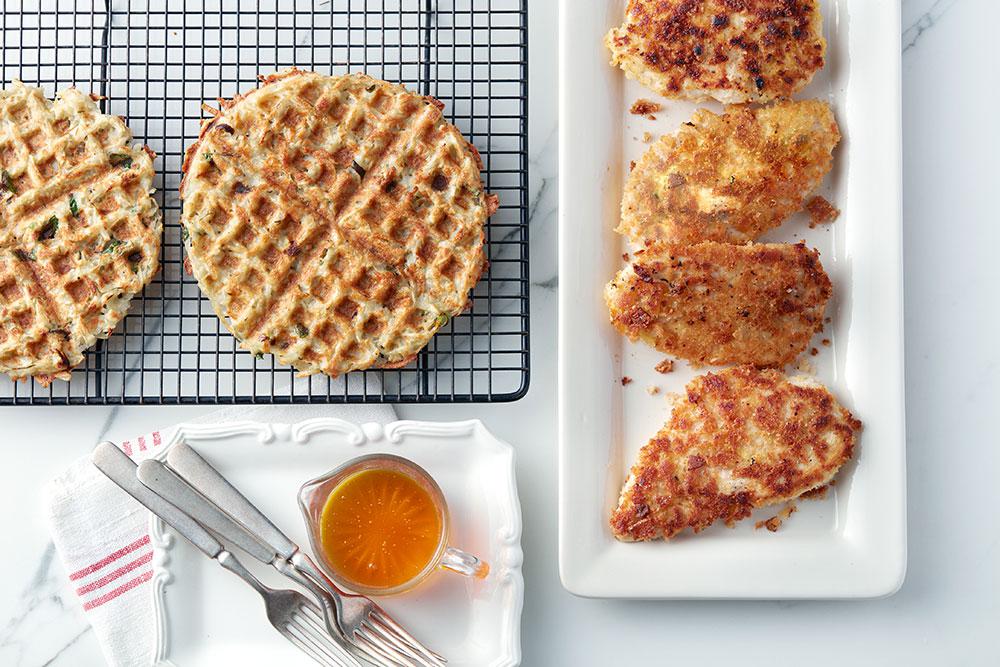
In the spirit of jazz improvisation, why not keep the creativity going? Hash browns are another breakfast favorite. What if the waffles are made from potatoes?

Voilà! The waffles are ready.

One note about making waffles from potato shreds. Potatoes are about 80 percent water, and the longer the shreds sit in the mixing bowl, the more water you’ll notice. For crispy hash brown potatoes, simply squeeze some of the moisture from the potatoes with two slotted spoons or use a colander to let the hash brown mixture drain. Once the waffle iron is warmed up and ready, it takes about 5-7 minutes for your waffles to emerge deliciously crunchy and ready to serve.

The New York Times reported the kitchen at Well’s Restaurant was often busiest at 2:00 a.m., but at your house Chicken-Fried Chicken over Potato Waffles is the go-to choice anytime you’re hungry for a change of pace and a fun, delicious meal. Top with honey, maple syrup or bacon crumbles. You’ll win over a legion of your own fans in no time.

For a short video history of chicken and waffles, watch this video documentary of Harlem’s food renaissance. The story of Well’s Restaurant begins at about the four minute mark.

Mac And Cheese Makeover

What’s in a name?

Macaroni and cheese seems entirely self-evident. There’s macaroni. And there’s cheese. Yes, there are more than 600 kinds of pasta, so there are plenty of options on that side of the equation. And of course, there’s always another kind of cheese to try. But what if you truly wanted to transform this comfort food classic, not only boosting the flavor but also adding lean protein? The result would be Smoky Chicken Mac ‘N Cheese.

Smoky yet sublime.

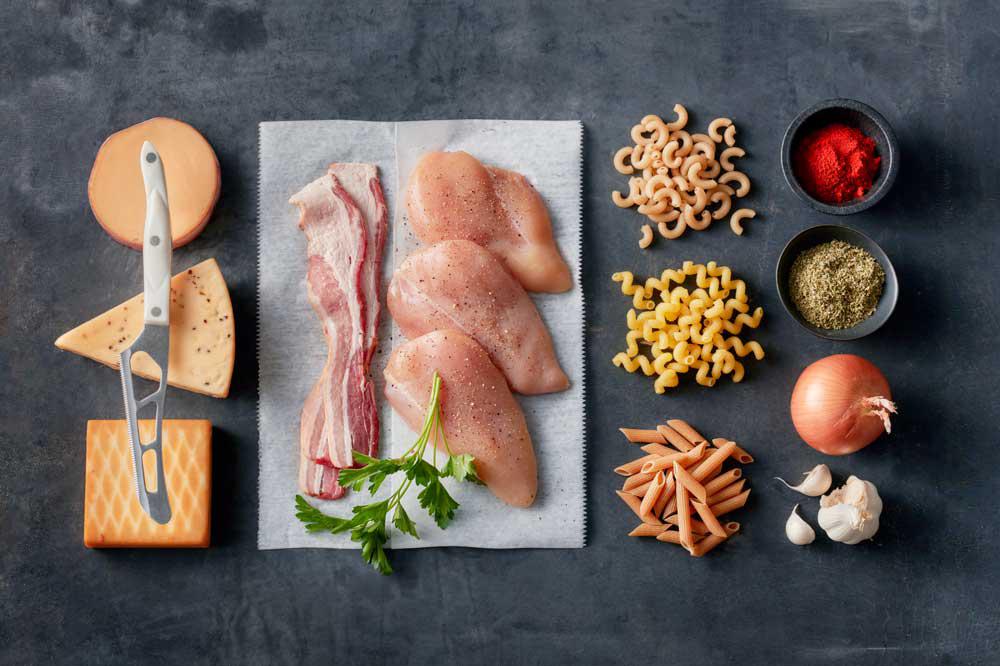
First things first, Smoky Chicken Mac ‘N Cheese is not a five-alarm fire. Instead, the smoky flavor comes from a sublime blend of smoked cheese, smoked paprika and bacon. Onion, garlic, oregano and tomato paste also contribute to the depth of flavor. And chicken? Fourteen ounces of chicken breast pack more than 110 grams of protein, so this is a dish sure to satisfy family and friends for dinner and one that reheats well the next day for a workday lunch.

The stuff of legends.

Any food that’s been around as long as pasta has accumulated a wealth of stories and legends. Did Marco Polo really bring pasta to Italy from China in the 13th century? Actually, pasta was in Europe long before that. Ancient Greeks and Romans made pasta with barley flour, and in Asia wheat noodles go back at least 4,000 years. In America, Thomas Jefferson was an early enthusiast for pasta and helped popularize mac ‘n cheese. He was introduced to pasta when he lived in Paris in the 1780s and later imported a pasta making machine to the United States. As president, he even served mac ‘n cheese at White House dinners

Flavor by the forkful.

Smoky Chicken Mac ‘N Cheese is delicious with a wide range of noodle types. Fusilli, penne or macaroni are all good choices. The short lengths and textured surfaces help the cheese adhere. For a gluten-free option, consider a brown rice pasta. And cheese? Try smoked cheddar, gouda or provolone. This recipe is all about comfort and creativity.

All The Greens

Get to know the full spectrum of leafy greens.

Kale, we’ll always be friends, but …

This isn’t forever. It’s just time to take a break. There’s an entire world of leafy greens out there to discover, and though certain varieties have had a good run (looking at you, kale), the two or three most common choices are just the tip of the iceberg lettuce. There’s an enormous range of flavor, and some veggies — escarole, for instance — taste different according to which part of the plant you’re using. With escarole, the green outer leaves are bitter while the white inner ribs and heart are mild. The versatility extends to cooking techniques as well. Greens can be sautéed, cooked with other ingredients, served raw and even grilled. Green means go, and there are plenty of ways to get more greens into your everyday meals.

As old as time, as fresh as today.

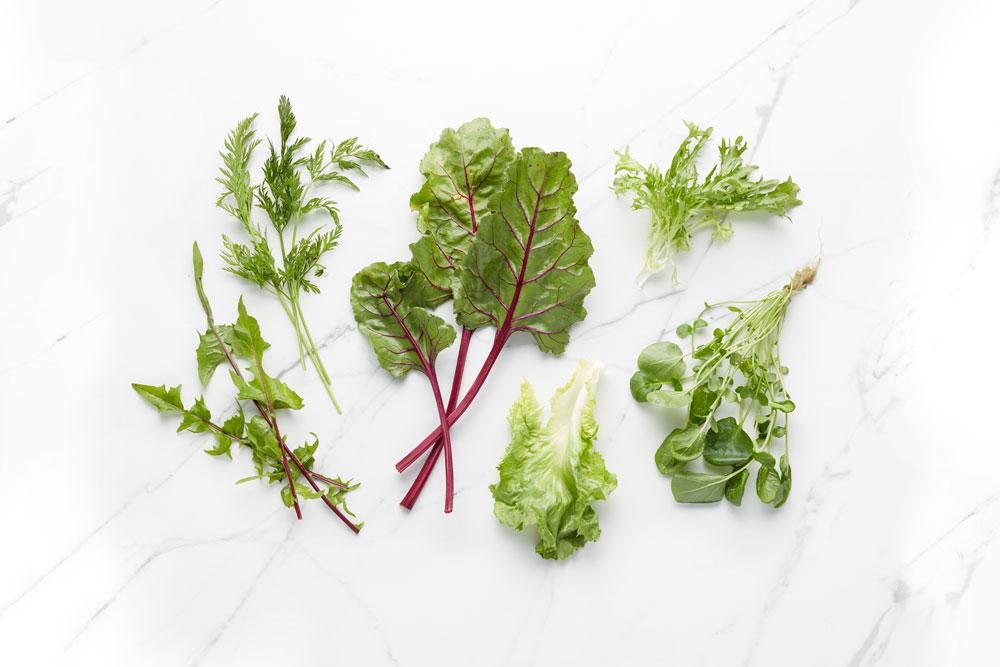
Humans have been eating greens for millennia. Depending on the time and place, greens can be a seasonal food or year-round staple. Some greens tolerate frost, which can extend their local availability into late fall or even early winter. And note, not all greens grow on land. Watercress, shown here on the far right, grows in or near freshwater springs and streams. Like all vegetables, the different varieties of greens support active, healthy living in different ways. But in general, leafy greens are excellent sources of vitamins, minerals, fiber and plant-based micronutrients.

Getting to the top of this.

When most people today think of beets, the part of the plant that comes to mind is the root. However, in the ancient world the plant was grown for its leaves, and it wasn’t until more recent centuries that the root was cultivated as a food source.

So what makes the beet greens such a super food for the ages? The leafy greens are packed with Vitamins A, B, C and K along with the minerals potassium, calcium, manganese and magnesium. Best of all, beets are often sold with the leaves and roots still attached, a 2-for-1 veggie combo that can serve as the basis for a well-rounded dinner.

Simply delicious.

If you browse the Just Bare Chicken online recipe collection, you’ll find an array of more delectable recipes that use enough greens to get you through the day!